
Your Supply Chain Doesn’t Have an AI Problem. It Has a Memory Problem.
- 2026-09-16
- Posted by: allen.yi
- Category: Supply Chain
Supply Chain AI can analyze more information than any supply chain manager could reasonably read in a lifetime. But what happens when the AI has access to the information it needs—and still gives management the wrong answer?
Consider a fairly ordinary product-mix decision.
Demand has shifted, and management is considering moving production from one air-conditioner model to another. The AI reviews the current forecast, customer orders, finished-goods inventory, factory capacity, component availability, supplier pricing, quality history, freight cost and contribution margin.
After running several scenarios, it recommends shifting 40,000 units.
Expected improvement in operating income: $1.3 million.
The analysis looks solid.
Except for one problem.
Three years earlier, Sourcing negotiated a compressor agreement that included a volume rebate. Several different air-conditioner models count toward the annual threshold. Reducing Model A production by 40,000 units causes projected purchases from that supplier to fall below the contractual threshold.
The company loses a $2.1 million rebate.
That $1.3 million “improvement” just became an $800,000 problem.
What went wrong?
The AI didn’t necessarily make a calculation error. The contract existed. Purchasing history existed. The bill of material existed. The production plan existed.
Nobody connected them.
And that may turn out to be one of the hardest problems facing Supply Chain AI.
We talk a great deal about giving AI more data. I am increasingly convinced that the harder challenge will be teaching it which pieces of old information matter to a decision nobody anticipated when that information was originally created.
Table of Contents
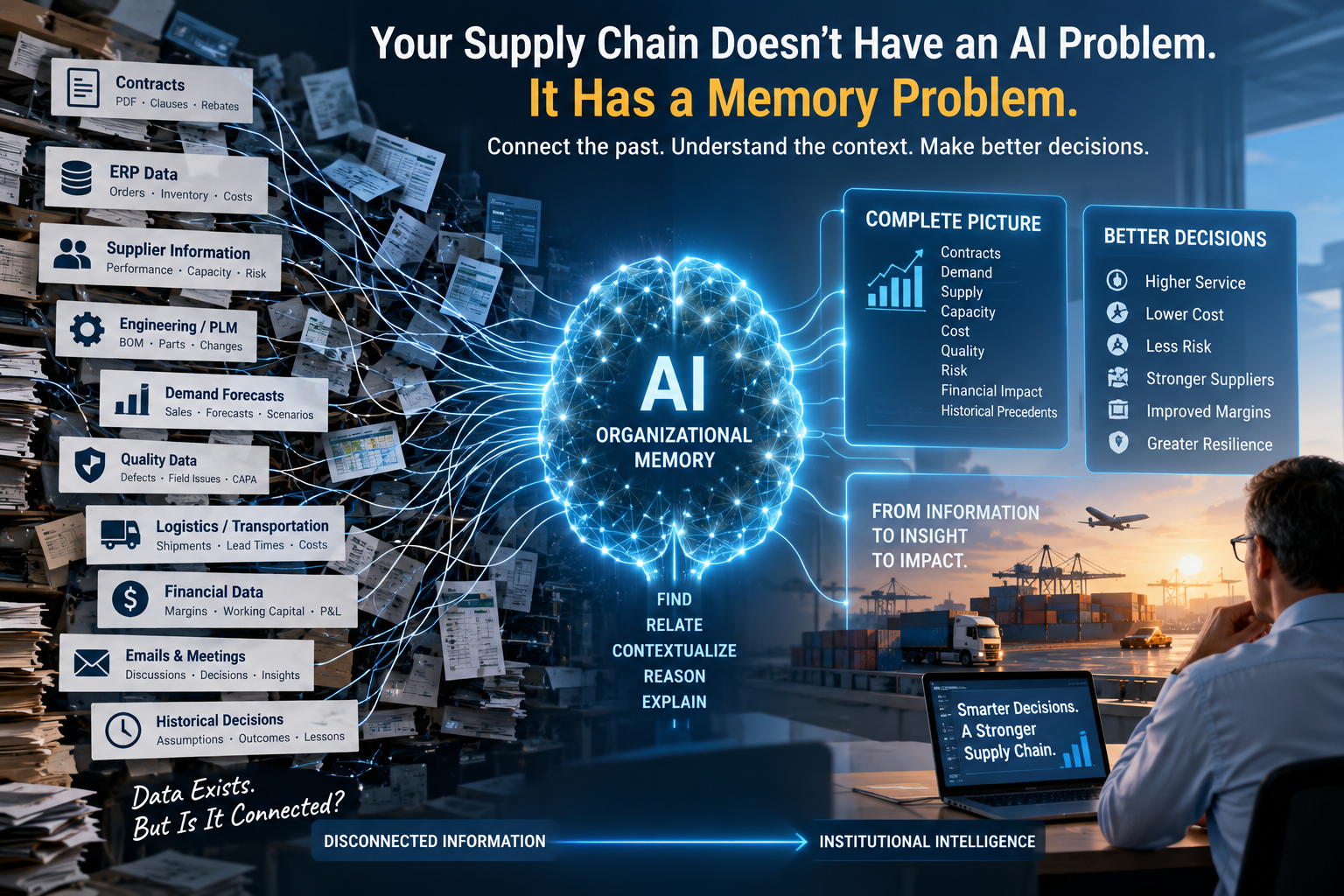
Supply Chain AI Already Has Plenty of Data
Large companies are hardly suffering from a shortage of systems.
There is ERP for transactions, APS for planning, PLM for product information, QMS for quality, WMS for warehouses, TMS for transportation and CRM for customers. Procurement may have supplier portals and contract-management systems. Engineering has drawings and specifications. Finance has its own reporting environment.
Then there are emails, meeting minutes, PowerPoint decks, supplier presentations and an extraordinary number of Excel files.
Anyone who has spent enough time in a large corporation has probably encountered a file resembling:
FINAL_Inventory_Analysis_v7_REVISED_FINAL2.xlsx
I have always wondered what happened to versions 1 through 6.
The important point is that most of these systems are quite good at remembering what they were designed to remember.
ERP can tell us that 8,000 units were ordered.
It usually cannot tell us that the buyer ordered 8,000 instead of 5,000 because the supplier privately warned about a holiday shutdown.
A planning system can tell us that someone overrode a forecast.
It may not tell us that Sales had just spoken with a retailer that expected a competitor to run out of inventory.
Procurement records may show that Supplier B costs 4% more than Supplier A.
They may not explain that management deliberately retained Supplier B because it repeatedly provided emergency capacity when Supplier A could not.
The transaction survives.
The reasoning often does not.
That distinction becomes much more important when Supply Chain AI starts making recommendations based on the history we have preserved.
A Company Can Store Information Without Remembering It
I think we use the word data too loosely when discussing AI.
A forecast changing from 10,000 to 14,500 units is data.
Knowing that 8,000 units are firm orders, 4,000 are a retailer forecast and 2,500 represent additional availability requested by Sales provides context.
Knowing that those additional units require a compressor covered by an annual supplier rebate creates a relationship.
Knowing that management previously faced a similar situation, chose to build the full forecast and later wrote off 1,700 units gives us experience.
Those are not the same thing.
This is why putting twenty years of corporate documents into a giant repository doesn’t create organizational memory.
It creates a very large repository.
The difficult part is establishing how one fact relates to another.
For Supply Chain AI to become genuine decision support, it needs more than the ability to find information. It needs enough context to understand why that information might matter.
The Information AI Needs May Be Three Years Old
Return to our compressor agreement.
The relevant provision might be buried on page 37 of a sourcing contract signed three years ago. It says that the company receives a rebate if annual purchases exceed a specified volume.
Management now asks:
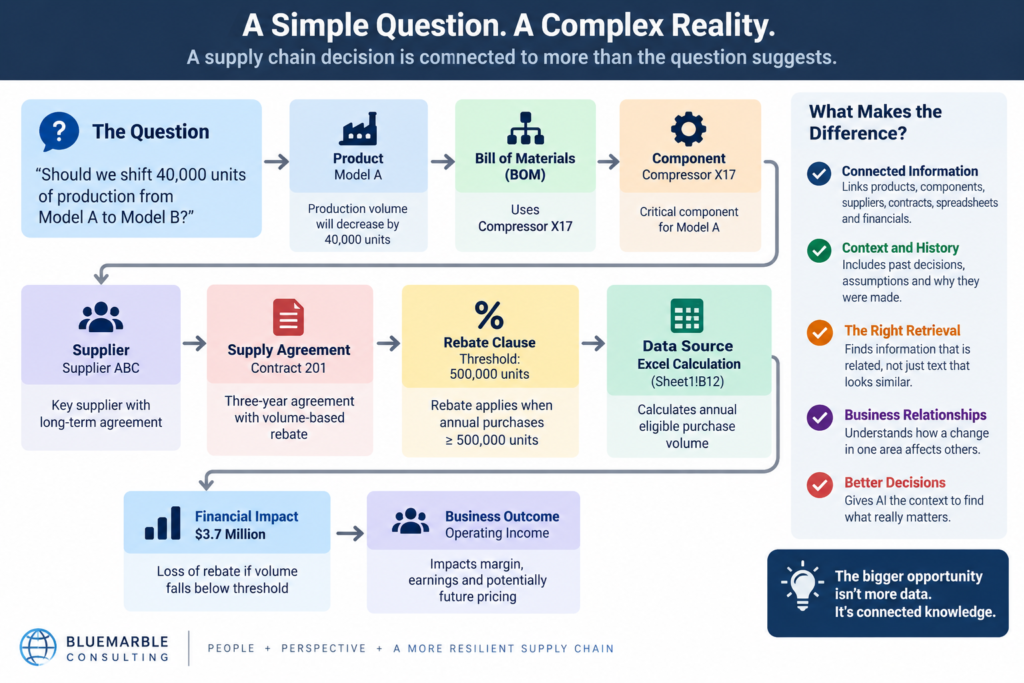
Should we shift production from Model A to Model B?
There is nothing in that question about rebates.
Nothing about the supplier.
Nothing about the contract.
Perhaps nothing about compressors.
Yet an intelligent supply chain system somehow needs to realize that all of them could affect the answer.
It may have to move through a chain like this:
Model A → BOM → Compressor X17 → Supplier ABC → Supply Agreement → Volume Rebate → Eligible Models → Projected Annual Purchases → Finance → P&L
That is considerably harder than finding a document containing words similar to the question.
Traditional retrieval-augmented generation, or RAG, can provide an AI model with information retrieved from corporate data. But complex enterprise questions may require understanding relationships across information that does not look semantically similar at first glance.
Graph-based approaches are one attempt to address this problem by representing entities and their relationships, allowing AI to explore connected information rather than relying entirely on similarity between a question and a document.
That matters enormously in supply chain because almost everything is connected to something else.
A supplier connects to plants.
Plants connect to parts.
Parts connect to BOMs.
BOMs connect to finished products.
Products connect to customers.
Purchases connect to contracts.
Contracts connect to pricing, rebates and liabilities.
And one seemingly simple production decision can travel through all of them.
The Hard Problem Is Knowing What to Retrieve
This leads to what I believe is one of the central technical challenges for Supply Chain AI.
The problem isn’t teaching AI to remember 50 million pieces of information.
The problem is teaching AI to recognize which 50 of those 50 million pieces matter to the decision being made.
A larger database doesn’t automatically solve that.
Neither does a larger AI context window.
The company needs relationships among the information.
And many of those relationships were never formally documented because experienced employees simply knew them.
The Missing Connection May Be the Relationship
Finding the right information isn’t always a search problem. Sometimes it is a relationship problem.
Consider our 40,000-unit production shift. Nothing in the question mentions compressors, suppliers or rebates. Yet the financial consequence may sit several connections away:
Model A → BOM → Compressor X17 → Supplier ABC → Contract → Volume Rebate → Annual Volume → Operating Income
A conventional retrieval system may find documents that resemble the question. A graph-based approach can also help AI follow relationships among products, components, suppliers, contracts, spreadsheets and decisions.
Even an Excel cell can belong to that chain. A volume calculation may depend on other cells, feed a rebate calculation and ultimately affect the financial forecast management sees.
But connecting information isn’t enough. AI still has to determine which relationships matter now, which source is authoritative and what has changed over time.
That’s the real retrieval challenge:
Don’t just find information related to the question. Find the information that could change the decision.
Much of the Relationship Still Lives Inside People’s Heads
A sourcing manager remembers that the compressor agreement contains a rebate.
Engineering knows which models use the compressor.
Planning knows which production volumes are changing.
Finance knows the rebate has already been included in the operating plan.
Quality knows that an alternate compressor has not completed validation.
Sales knows why the forecast moved.
Individually, everyone may be correct.
Collectively, the company may still fail to connect the information.
Experienced managers make these connections almost unconsciously.
Someone proposes reducing production and a sourcing manager thinks:
Wait. What does that do to our annual supplier volume?
That leads to another thought:
Didn’t we have a rebate threshold?
Then:
Which other models count toward it?
And eventually:
Has Finance already included that rebate in the operating plan?
This is especially important in strategic sourcing, where experienced managers often carry years of supplier, commercial and operational knowledge that never makes it into the system.
The experienced person doesn’t merely know more answers.
The experienced person knows which questions should come next.
For enterprise AI, that may be just as important.
Can AI Build Its Own Organizational Memory?
It is unrealistic to expect employees to manually map every relationship inside a global enterprise.
There are too many suppliers, parts, contracts, plants, products, customers and decisions.
AI will therefore need to help construct the organizational memory it consumes.
Suppose the system reads the compressor agreement and identifies:
- supplier,
- eligible part families,
- rebate percentage,
- volume threshold,
- measurement period,
- effective dates,
- exclusions,
- and expiration date.
It finds those part numbers in ERP.
It connects them to BOMs in PLM.
It identifies the finished products consuming those components and compares projected purchases with the contractual threshold.
Then it discovers an amendment signed eighteen months later.
Now Supply Chain AI faces another problem.
Does the amendment replace the original provision or supplement it?
Perhaps aftermarket purchases were included in the original agreement but excluded by the amendment.
This is exactly where the system should not quietly manufacture certainty.
It should ask.
A sourcing manager might receive:
Amendment #2 appears to exclude aftermarket volume from the annual rebate calculation. I found projected aftermarket purchases currently included in Finance’s rebate forecast. Please confirm whether Amendment #2 supersedes the original definition of eligible purchases.
AI discovers a possible relationship.
A knowledgeable human validates it.
The validated relationship becomes organizational knowledge.
The next employee doesn’t have to rediscover it three years later.
This kind of relationship-oriented retrieval is one reason knowledge graphs and approaches such as GraphRAG are attracting attention. Microsoft Research describes GraphRAG as combining text extraction, network analysis, LLM prompting and summarization to create knowledge graphs that represent entities and their relationships.
That doesn’t magically solve the enterprise-memory problem.
But it points toward the kind of architecture that may be required.
Old Knowledge Can Be as Dangerous as Missing Knowledge
There is another complication.
Companies change.
Suppliers change.
Contracts change.
Customers change.
Factories change.
Strategies change.
Even the meaning of a KPI can change.
Suppose Supplier ABC historically struggled whenever annual volume exceeded 500,000 units.
That would be useful information when evaluating future allocation.
Then the supplier installs a new automated production line and expands sustainable capacity.
Should AI forget the old history?
No.
Should it continue treating the old capacity limitation as current reality?
Also no.
The AI needs to understand that the historical observation was valid under a previous set of conditions.
The same applies to contracts.
The 2023 agreement may have been correct.
A 2025 amendment may also be correct.
One describes what was true then.
The other describes what is true now.
An organizational memory that cannot distinguish between those two things can confidently retrieve the wrong answer.
That can be more dangerous than simply saying:
“I don’t know.”
The 14,500-Unit Forecast That Isn’t Really 14,500
Consider another Supply Chain AI problem.
A residential air-conditioner business has a June forecast of 10,000 units.
Sales increases the requirement to 14,500.
At first glance, this looks like a forecasting problem.
But after talking with Sales, we discover that the 14,500 consists of:
- 8,000 relatively firm customer orders,
- 4,000 units from a retailer forecast,
- 2,500 units Sales wants available in case the market strengthens.
Those three numbers should not carry the same confidence.
Marketing then says it wants more of the higher-margin model.
Sourcing points out that incremental compressor purchases will create an unfavorable purchase-price variance and may affect the supplier rebate.
Quality objects because the higher-margin model has a field-failure rate above target.
Material Planning wants enough components available in case Production needs them.
Production says it can make 12,800 units without overtime but wants to know which week the additional units are required.
Fulfillment worries about inventory.
Finance worries about working capital.
Sales worries about lost revenue.
What is the correct answer?
There may not be one.
This is one reason S&OP and IBP exist in the first place.
A supply chain is not one optimization problem. It is a collection of legitimate but partially conflicting objectives that management has to reconcile.
And that creates another challenge for AI.
Supply Chain AI Can Inherit the Company’s Biases
Corporate information isn’t merely incomplete.
It can reflect the incentives of the people who created it.
Sales is measured partly on revenue and availability.
Sourcing may be measured on purchase-price variance or savings.
Manufacturing cares about utilization and production stability.
Quality worries about field failures.
Logistics cares about service and transportation cost.
Finance cares about margin, cash and working capital.
None of those perspectives is necessarily wrong.
But incentives influence what people emphasize and sometimes what they record.
Suppose Sales believes a customer forecast may be reduced later but does not want Planning to reduce supply because product availability is critical to the revenue plan.
Planning accepts the demand.
Procurement buys material.
Manufacturing builds.
Three months later Finance asks why inventory is too high.
Every system may have functioned exactly as designed.
The missing information was the uncertainty surrounding the original demand signal and how strongly each function believed it.
Supply Chain AI therefore needs to distinguish between different kinds of information.
A supplier saying, “We have enough capacity,” is not the same as a validated capacity study.
A salesperson saying, “The customer will probably take another 5,000,” is not the same as a purchase order.
A model predicting a shortage is not the same as an observed shortage.
A management assumption is not a contractual obligation.
If all of those become indistinguishable entries in a corporate knowledge base, we haven’t created institutional intelligence.
We have created a very sophisticated rumor mill.
What We Really Need to Preserve Is the Decision
Return to the 14,500-unit forecast.
Most companies can preserve this:
Forecast: 10,000 → 14,500
A more useful organizational memory might preserve:
| Decision element | What was known at the time |
|---|---|
| Original forecast | 10,000 units |
| New demand signal | 14,500 units |
| Firm demand | 8,000 units |
| Retailer forecast | 4,000 units |
| Availability protection | 2,500 units |
| Sales confidence | Moderate |
| Production without overtime | 12,800 units |
| Quality concern | Higher failure rate on Model B |
| Sourcing concern | Compressor cost and rebate exposure |
| Finance concern | Working-capital exposure |
| Decision | Produce 12,800 initially |
| Reconsideration trigger | Stronger retailer commitment |
| Actual demand | 12,850 units |
Now something different has been created.
We don’t merely know what demand eventually turned out to be.
We know what management knew at the time, where functions disagreed, what assumptions were accepted, what decision was made and what happened afterward.
That is organizational experience.
After enough decisions, Supply Chain AI could potentially ask a much more useful question than:
What happened last time demand increased 40%?
It could ask:
What happened in previous situations where demand increased sharply, less than 60% of the increase was firm, supplier capacity was constrained and Sales confidence was moderate?
That is much closer to how experienced people reason.
Why Management Still Won’t Hand AI the Keys
Even excellent organizational memory doesn’t mean management will surrender consequential decisions to AI.
Imagine Supply Chain AI recommends reducing inventory by $20 million.
The system says:
Recommended action: Reduce safety stock by 18%. Confidence: 91%.
What does the VP say?
Probably:
“Why?”
And that is a perfectly reasonable response.
If service subsequently collapses and the company misses $50 million of customer shipments, the AI isn’t sitting in the CEO’s office explaining the quarter.
The VP is.
The same applies to sourcing.
If AI recommends awarding 60% of a commodity to a lower-cost supplier and that supplier fails during launch, the sourcing organization owns the consequences.
Analytical capability and decision authority are not the same thing.
NIST’s AI Risk Management Framework makes a similar distinction at a broader level by treating accountability, transparency, explainability and interpretability as characteristics of trustworthy AI systems.
For supply chain leaders, those abstract terms become very practical.
Management needs to understand the business case before accepting the risk.
Supply Chain AI Must Explain the Business Case
For a consequential recommendation, management may need to see:
- evidence used,
- assumptions made,
- financial effect,
- service implications,
- inventory consequences,
- supplier and capacity risks,
- quality implications,
- historical precedents,
- alternative scenarios,
- contradictory evidence,
- confidence,
- and conditions that would invalidate the recommendation.
Much of this should be visual.
Suppose Supply Chain AI recommends reducing safety stock from 42 days to 31.
It shouldn’t merely say:
Recommended reduction: 11 days.
It should show why.
Perhaps demand variability has declined.
Supplier lead-time variability has improved.
Forecast bias has stabilized.
Service remained above target during comparable demand peaks.
Management should then be able to examine several scenarios:
42 days. 36 days. 31 days. 25 days.
How much working capital is released?
How does service risk change?
What happens if Supplier B slips three weeks?
What happens if demand is 15% above forecast?
What assumptions are driving the result?
And perhaps most importantly:
What evidence argues against the AI’s own recommendation?
A system that can tell management why it might be wrong is far more useful than one that simply assigns itself 91% confidence.
AI Should Be Able to Argue Against Itself
This may become one of the most important capabilities of decision-oriented Supply Chain AI.
Suppose the recommendation is:
Increase Supplier B allocation from 30% to 45%.
The supporting evidence might include:
- lower landed cost,
- improving on-time delivery,
- available capacity,
- favorable recent quality performance.
But the system should also surface evidence against its recommendation:
- limited history at the higher volume,
- an open corrective action,
- potential rebate consequences with Supplier A,
- tooling ownership concerns,
- greater geographic concentration.
Management now sees the tradeoff rather than simply the answer.
That is closer to how good executive decisions are made.
Explainability in Supply Chain Is a Business Problem
When people discuss explainable AI, the conversation can become technical very quickly.
A supply chain executive generally doesn’t need to understand the mathematics inside the model.
The executive needs to understand the business reasoning.
Why are you recommending this?
Which information did you use?
Which information could you not find?
Which contract provisions affect the result?
Which assumptions matter most?
What changed since the last decision?
Which functions disagree?
What comparable situations did you examine?
Which alternative did you reject?
What happens if demand is lower?
What happens if the supplier is late?
At what point should we reverse the decision?
NIST notes that explainability and interpretability need to be considered in relation to the intended users and the context in which AI output will be used.
For a supply chain VP, that means the explanation needs to support an actual business decision—not merely explain how an algorithm works.
Supply Chain AI May Become an Extraordinary Staff Organization
The future system may therefore look less like an autonomous robot running the supply chain and more like an extraordinarily capable staff organization.
Imagine entering an S&OP meeting.
Instead of 50 slides assembled over three days by several functions, the AI has already reviewed contracts, BOMs, forecasts, supplier history, quality data, capacity, inventory, previous decisions and financial implications.
It presents three scenarios.
It explains why it prefers one.
It shows the numbers in tables.
It plots the tradeoffs in charts.
It identifies the major risks.
It tells management which assumptions are weak.
Then the VP asks:
“What if Sales is right and demand is 15% higher?”
The analysis changes.
“What if Supplier B slips three weeks?”
Another scenario.
“Why did you include the rebate?”
The contract provision appears.
“Wasn’t that agreement amended?”
The amendment appears beside it.
“Show me what happened the last five times we faced something similar.”
There they are.
At that point, AI is doing something much more important than generating a forecast.
It is helping management think.
This Is Bigger Than Connecting AI to ERP
If companies want this level of Supply Chain AI, connecting an LLM to an ERP system will not be enough.
The information environment eventually needs to connect operational systems, documents and human knowledge.
ERP, APS, PLM, QMS, WMS, TMS and CRM remain important systems of record. Contracts, supplier correspondence, meetings and other less-structured information add context.
Relationships need to connect suppliers to plants, parts to products, products to customers, contracts to purchases, engineering changes to quality controls and decisions to outcomes.
Time has to be preserved so the system knows what is true now and what used to be true.
Provenance needs to show where information came from.
Permissions still matter.
And AI needs to retrieve information relevant to the decision rather than simply retrieve documents containing similar words.
Microsoft Research’s GraphRAG work illustrates one technical direction for richer retrieval: extracting entities and relationships from private text collections and using the resulting graph structure to provide context for complex queries.
But technology alone won’t solve the problem.
A useful operating cycle may eventually resemble:
Capture → Structure → Relate → Contextualize → Govern → Retrieve → Reason → Challenge → Explain → Decide → Execute → Observe → Learn
That may look like an IT architecture.
It really isn’t.
It is an organizational architecture.
Technology can help connect information. It cannot magically reconstruct reasoning the organization never captured, resolve KPI conflicts management never addressed, or know that an undocumented supplier conversation mattered unless someone—or eventually the AI itself—recognizes the relationship.
The Real Advantage May Be Institutional Intelligence
Imagine two competing manufacturers several years from now.
Both have access to excellent AI models.
Both have modern ERP systems.
Both have sophisticated forecasting.
Both can process enormous amounts of information.
One company primarily uses AI to automate reports, summarize documents, generate forecasts and answer questions.
The other has spent years building something more difficult.
It has preserved not only transactions but important assumptions, relationships, disagreements, decisions and outcomes.
Its Supply Chain AI knows that a particular compressor contract affects four product families.
It knows the contract was amended.
It knows why the company previously retained a higher-cost supplier.
It knows that Sales forecasts become less reliable when availability requests are mixed with firm demand.
It knows that a supplier’s old capacity limitation became less relevant after a new production line was installed.
And when it doesn’t know, it knows enough to ask.
That company has not merely accumulated more data.
It has accumulated institutional intelligence.
There is still one final requirement.
When a new problem arrives, AI must recognize which tiny portion of that accumulated experience matters now. Then it must connect that information across functions, determine what has changed, build the business case, expose weaknesses in its own reasoning and explain the recommendation well enough that accountable human beings are willing to act.
The future advantage may therefore not belong to the company with the smartest AI.
It may not even belong to the company with the most data.
It may belong to the company whose Supply Chain AI can find the right memory, understand why it matters now, connect it to the rest of the business, and explain the decision well enough for management to challenge it.
Your supply chain doesn’t simply need artificial intelligence.
It needs institutional intelligence.
And institutional intelligence requires more than remembering what happened.
It requires knowing what matters, what it connects to, what has changed, what is still true—and why a human being responsible for the consequences should believe it.
Frequently Asked Questions About Supply Chain AI
What is Supply Chain AI?
Supply Chain AI is the use of artificial intelligence to analyze, support or automate activities such as demand planning, inventory management, sourcing, supplier management, manufacturing, logistics and cross-functional decision-making. More advanced systems may also retrieve information across enterprise systems, investigate exceptions, generate scenarios and help execute approved actions.
Why does Supply Chain AI need organizational memory?
Historical transactions show what happened, but important supply chain decisions also depend on why something happened. Forecast assumptions, supplier commitments, management decisions, contract provisions and previous outcomes can provide context that transactional data alone may not contain.
Why isn’t clean supply chain data enough for AI?
Clean data is important, but a decision can depend on relationships among otherwise accurate information. A production decision, for example, could affect component purchases, contractual rebates, supplier capacity, inventory, quality and working capital. AI must recognize those relationships before it can evaluate the total business impact.
What is a knowledge graph in Supply Chain AI?
A knowledge graph represents entities and relationships among them. In supply chain, those entities might include suppliers, facilities, components, finished products, contracts, customers and business decisions. Graph-based retrieval can help AI discover information through those relationships instead of relying only on keyword or semantic similarity.
Can Supply Chain AI make decisions autonomously?
Some routine, low-risk decisions may become increasingly automated. Consequential decisions involving large financial commitments, supplier relationships, customer service, quality or strategic risk are more likely to require human oversight, particularly when assumptions and tradeoffs must be evaluated.
Why is explainability important in Supply Chain AI?
Supply chain managers are accountable for business outcomes. For important decisions, they need to understand the evidence, assumptions, risks, alternatives and expected consequences behind an AI recommendation. Explainability therefore becomes part of management decision support, not merely a technical AI feature.
Will AI replace ERP, APS, WMS or other supply chain systems?
Not necessarily. Those platforms remain important systems of record and execution. AI may increasingly operate across them, retrieve information from them and connect information that previously remained separated across different applications.
What is institutional intelligence?
Institutional intelligence is the organization’s accumulated understanding of how its business actually works—including data, relationships, historical decisions, assumptions, outcomes and lessons learned. AI can potentially make that knowledge easier to preserve, retrieve and apply to future decisions.