

Amazon FBA Alternative: A Smarter Response to Rising Fulfillment Costs
- 2026-07-21
- Posted by: allen.yi
- Categories: Logistics, Supply Chain, Transportation, Warehousing
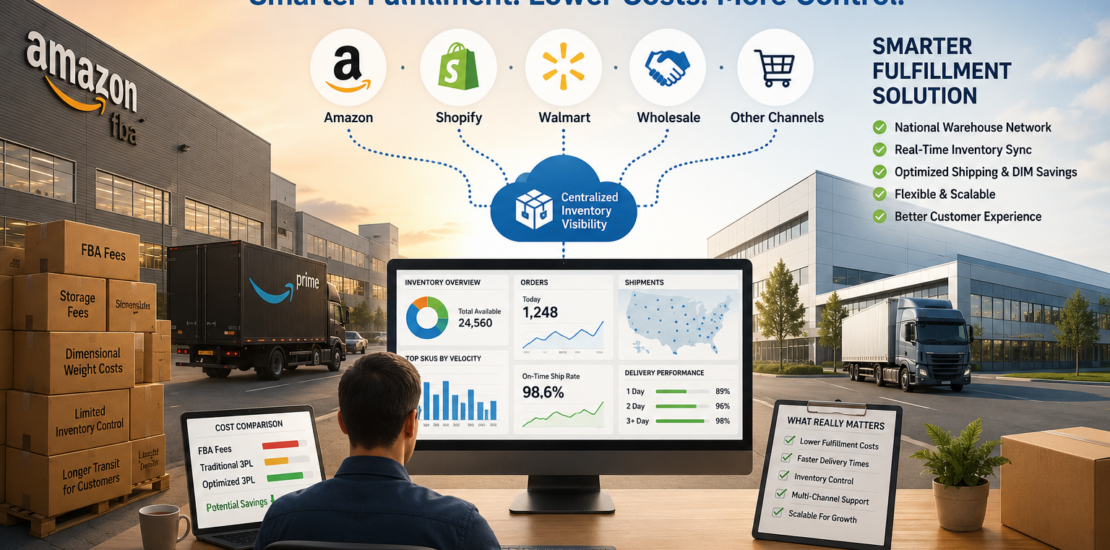

Table of Contents
An Amazon FBA alternative usually becomes worth considering after FBA has already done its job.
For many sellers, Fulfillment by Amazon is one of the reasons the business was able to grow in the first place. It removes the need to lease warehouse space, hire fulfillment labor, negotiate parcel rates, and spend every afternoon wondering why yesterday’s orders still have not been picked. Inventory goes into Amazon’s network, eligible products receive Prime exposure, and the seller can focus on merchandising, advertising, and product development.
That model can work extremely well when the catalog is manageable, the products fit comfortably inside standard parcel dimensions, and most demand comes through Amazon.
Growth changes the equation.
A company adds Shopify, then Walmart, then wholesale. A seasonal product needs to arrive months before peak demand. A bulky item looks profitable on the product-cost spreadsheet but loses its margin once dimensional weight is applied. Inventory begins to sit in several locations, each with its own count, status, and replenishment logic.
Nothing necessarily breaks overnight. Fulfillment performance usually deteriorates by degrees: a little more storage expense, a few more split shipments, more manual inventory adjustments, and an increasing number of meetings devoted to explaining why systems that are technically connected still do not agree.
The question is no longer whether FBA is good or bad. It is whether the fulfillment structure still matches the business.
When FBA Starts Restricting the Business
FBA is designed around Amazon’s marketplace, Amazon’s delivery promise, and Amazon’s customer experience. That focus is precisely what makes the program effective, but it can become restrictive once the seller’s business expands beyond Amazon.
Consider a company that begins with 20 SKUs and one sales channel. The operation is easy to understand: purchase inventory, prepare it according to FBA requirements, send it into the network, and monitor replenishment.
As the catalog grows, the seller may begin using Amazon’s Fulfilled by Merchant option for selected products while keeping other SKUs in FBA. This can provide more control over inventory, packaging, and fulfillment decisions, but it also means the seller—or its 3PL—must take responsibility for storage, order processing, shipping, tracking, and customer-service performance.
Three years later, the same company may have 200 SKUs, a Shopify store, a Walmart account, several wholesale customers, and a retailer asking for drop-ship capability. Some inventory sits in FBA, merchant-fulfilled stock is stored at a 3PL, wholesale cases are held elsewhere, and returns are being processed at yet another location.
From a distance, the company has plenty of inventory and more than enough warehouse capacity. At the SKU level, however, availability is much harder to interpret. Stock exists, but it may not be available for the order that needs it.
That is usually when the original fulfillment model begins influencing commercial decisions. Sales may hesitate to accept a wholesale order because inventory is committed to FBA. Marketing may delay a promotion because the Shopify stock position is unclear. Purchasing may overbuy because no one fully trusts the available-to-promise quantity.
The business has not run out of inventory. It has lost flexibility in how that inventory can be used.
Storage Cost Is Really an Inventory-Placement Problem
Sellers often compare storage rates as though cost alone determines whether inventory is well managed. In reality, the larger issue is whether each SKU is stored in a location that matches its velocity, cube, seasonality, and service requirement.
Fast-moving products belong near active fulfillment capacity. Slow movers may be better held in lower-cost reserve storage. Seasonal inventory may need to arrive early, but that does not mean every unit should immediately occupy premium pick-face space.
These distinctions sound obvious, yet many e-commerce companies treat inventory as one undifferentiated pool.
A patio-products seller may bring in containers during winter to prepare for spring demand. If all of that inventory is placed into expensive fulfillment space too early, storage costs begin accumulating months before the selling season starts. Waiting too long creates the opposite problem: missed demand, rushed replenishment, and premium transportation.
The financial effect extends beyond warehouse rent. Inventory paid for today may remain unsold for months, which is one reason export cash flow problems can quietly restrict growth. The business has money tied up in products, ocean freight, duties, storage, and domestic transportation long before it collects revenue from the final customer.rushed transfers, or premium transportation charges.
A better approach separates reserve stock from forward fulfillment stock. The reserve quantity protects supply, while the forward quantity supports near-term orders. Replenishment between the two should follow demand signals, lead times, and SKU-level velocity rather than broad rules applied across the entire catalog.
This is standard inventory segmentation, but many sellers do not adopt it until storage expense becomes painful enough to force the issue.
The same logic applies to network placement. A high-volume SKU may justify inventory in several regions, whereas a low-volume accessory might be better served from one central location. Distributing both products identically creates more safety stock without necessarily improving service.
Storage cost, in other words, is rarely just about the warehouse rate. It is the financial result of allocation decisions made earlier.
Multichannel Growth Exposes Weak Inventory Controls
Opening another marketplace is relatively easy. Keeping inventory synchronized across that marketplace, Amazon, Shopify, and the warehouse is where the real work begins.
Suppose a seller has 40 units available and pushes that same count to Amazon, Walmart, and Shopify. Unless the systems reserve inventory in real time, the company is effectively promising 120 units while physically owning only 40.
This is one of the most common hidden inventory problems that destroy growth. The stock may appear available in every system, yet some units may already be committed, waiting for inspection, damaged, or sitting in a location that cannot fulfill the next order.
The gap often remains hidden during normal demand. It usually surfaces during a promotion, product launch, flash sale, or seasonal surge, when orders arrive faster than the systems can reconcile them.
Once overselling starts, every department feels it.
Customer service deals with cancellations and delayed orders. Purchasing places expedited replenishment orders. Warehouse employees perform physical searches because the system shows inventory that has already been allocated elsewhere. Finance sees higher freight and lower margin but may not immediately connect those costs to inventory synchronization.
The operational requirement is real-time inventory reconciliation at the SKU and location level. The seller also needs buffer-stock rules that account for channel priority, order latency, returns, damaged goods, and inventory that is physically present but not yet available for sale.
That last distinction is often overlooked.
A product may have arrived at the warehouse but still be waiting for receiving, inspection, labeling, or putaway. Counting that unit as immediately available can create the same overselling risk as an inaccurate physical count.
As order volume rises, inventory status must become more precise. “In the building” is not the same as “available to promise.”
Each Sales Channel Creates a Different Warehouse Workflow

Multichannel fulfillment is often described as though every order enters one queue and follows the same process.
Warehouse operators know better.
An Amazon order may require same-day dispatch, approved carrier services, and valid tracking within a strict window, while a Shopify order may need branded packaging, an insert, and a different return label. Wholesale shipments can involve case packs, pallet configuration, appointment scheduling, advanced shipping notices, and retailer-specific labels.
The product may be identical, but the work content is not.
This matters because warehouse labor is consumed by steps, not by marketing channels. Every additional label, scan, inspection, insert, carton rule, or routing requirement adds time and creates another point where an order can fail.
A capable fulfillment platform should therefore convert channel rules into executable warehouse instructions. When an order drops, the system should identify the correct packaging method, carrier service, cutoff time, documentation, and exception logic without requiring the picker or packer to remember which customer has which rule.
Companies that lack this control usually compensate with printed SOPs, spreadsheets, shared folders, and tribal knowledge. Those tools can hold an operation together at modest volume, but they become difficult to govern once order profiles multiply.
The goal is not to eliminate human judgment. It is to reserve human judgment for exceptions instead of relying on it for routine execution.
A Real Example from an Oversized-Product Seller

Sunnydaze Decor, a Wisconsin-based seller of outdoor fountains, fire pits, hammocks, patio furniture, garden products, and seasonal décor, offers a useful example of how fulfillment requirements change with scale.
Its product mix is operationally demanding. Many items occupy substantial cube, require careful packaging, and generate freight charges based on dimensional rather than actual weight. Serving customers nationwide from one Midwestern warehouse also creates an unavoidable transit-time disadvantage for distant regions.
The company initially fulfilled orders through its own Wisconsin operation. That arrangement provided control, but national one- and two-day delivery became increasingly difficult as volume expanded. Faster service to distant customers required more expensive transportation, and the cost per order varied significantly depending on destination and package dimensions.
Sunnydaze later moved part of its Seller Fulfilled Prime volume into a technology-enabled national fulfillment network.
According to a case study published by the fulfillment provider, eligible products achieved nationwide one- to two-day delivery, delivery cost per order declined, and enrolled SKUs produced a 20% sales increase. Because the provider published the results, they should be viewed as reported customer outcomes rather than independently audited findings.
Even with that qualification, the case is useful because the operating challenge is easy to understand.
Sunnydaze did not simply need more warehouse space. It needed inventory closer to demand, workflows capable of meeting Prime requirements, and a parcel strategy designed around large products.
Those are different problems, but they had to be solved together.
Dimensional Weight Changes the Economics of Bulky Products
Large products can carry healthy gross margins at the factory level and disappointing margins after fulfillment.
The main reason is dimensional weight.
Parcel carriers calculate dimensional weight by converting package volume into a billable weight. When dimensional weight exceeds actual weight, the package is charged as though it weighs more than it does.
A lightweight fountain, pet bed, storage bin, chair, or fitness accessory may therefore produce a shipping bill that seems disconnected from the scale weight. The carrier is charging for the space occupied inside its network.
For sellers in bulky-product categories, fulfillment economics depend on several operating variables at once:
- carton dimensions and void space
- packaging material and product protection
- zone distance
- residential-delivery exposure
- carrier DIM divisor
- negotiated parcel rates
- split-shipment frequency
- warehouse location
- damage and return rates
This is why comparing 3PLs on pick fees alone can be misleading. A provider may charge slightly more for handling but reduce total delivered cost through better cartonization, stronger carrier rates, or a warehouse location closer to the customer.
Packaging engineering can also create savings that are larger than expected.
Reducing one carton dimension by a few inches may move the package into a lower billable-weight bracket. Across thousands of shipments, that change can matter more than negotiating a small reduction in the pick fee.
Bulky-product fulfillment should therefore be evaluated on total landed delivery cost, not warehouse labor in isolation.
Seller Fulfilled Prime Requires More Than Fast Shipping
Amazon’s official Seller Fulfilled Prime program allows qualified sellers to display the Prime badge while fulfilling orders outside Amazon’s warehouse network, provided they complete the required trial and continue meeting Amazon’s performance standards.
For sellers that want greater control over inventory, packaging, or oversized products, that can be an attractive option. However, Seller Fulfilled Prime should not be viewed as ordinary merchant fulfillment with a Prime logo added to the listing. The warehouse and transportation network must consistently support the delivery promise behind the badge.
Prime performance depends on several connected activities: order acceptance, same-day processing, accurate inventory allocation, approved carrier service, valid tracking, weekend operations, and final delivery. A seller can execute the pick-and-pack process correctly and still miss the customer promise when inventory is located too far from the destination.
A single warehouse may provide dependable two-day delivery within its surrounding region, but national coverage usually requires one of two things: premium transportation or inventory distributed across multiple fulfillment centers. The first raises parcel cost, while the second creates additional forecasting, replenishment, and safety-stock requirements.
The most practical model usually combines both approaches selectively. High-velocity SKUs can be positioned closer to major demand regions, while slower products remain centralized. Carrier selection should account for shipping zone, warehouse cutoff time, service reliability, and the likelihood of meeting the promised delivery date—not merely the lowest available rate.
Amazon’s performance requirements make weak fulfillment execution visible quickly. Late shipments, invalid tracking, cancellations, and missed delivery commitments can affect Prime eligibility and offer performance. Any fulfillment provider supporting Seller Fulfilled Prime therefore needs both marketplace expertise and a warehouse network designed around the required service levels.
Software Cannot Compensate for Weak Warehouse Execution
A polished fulfillment dashboard can create confidence, but the physical process still determines whether the customer receives the correct product on time.
Inventory software can show expected stock. A WMS can direct a picker to a bin. A transportation system can select a carrier. None of those tools can correct an unprocessed receipt, an incorrect carton dimension, a missed scan, or a product stored in the wrong location.
The most common system failures in fulfillment often begin as execution failures. Receiving falls behind, so inventory remains unavailable longer than expected. Cycle counts are skipped, causing book inventory to drift away from physical inventory. Packaging data is entered incorrectly, so the rate engine evaluates shipping options using the wrong dimensional weight.
These are examples of a wider operational visibility problem. When receiving, inventory, order management, and shipping do not update one another reliably, managers may see a clean dashboard while warehouse employees are already working around inaccurate information.
This is one reason direct competitors in this market combine fulfillment software with physical warehouse operations.
The software and the building operate under one control structure. Orders enter the platform, inventory is allocated, tasks are released to the floor, labels are generated, and status changes are captured during execution.
That integration does not eliminate mistakes, but it shortens the distance between the transaction recorded in the system and the activity taking place in the warehouse.
For a seller evaluating providers, that distance matters more than the number of charts on the dashboard.
Distributed Fulfillment Works Only with Disciplined Allocation
A national warehouse footprint can reduce transit time and parcel zones, but it also introduces a new planning problem: how much of each SKU belongs in each location?
The wrong answer creates either service failures or excess inventory.
If too little inventory is placed near demand, orders will cross the country and incur higher shipping costs. If too much is distributed, stock becomes stranded and the seller carries unnecessary safety inventory.
A disciplined network uses velocity, regional demand, seasonality, replenishment lead time, and service level to determine placement. Sellers also need systems that can manage inventory across multiple locations accurately, so each warehouse reflects its own available stock rather than relying on one blended company-wide total.
High-volume products with broad national demand may justify several stocking points. Lower-volume SKUs may remain in one central facility. Seasonal goods may be repositioned before demand changes, while products with unpredictable regional demand may need more conservative allocation.
The provider should also have a clear process for rebalancing stock. Forecasts are never perfect, and demand rarely develops exactly as planned. Inventory transfers, replenishment thresholds, and exception alerts should be part of the operating model.
Without that discipline, a multi-node network can reduce delivery time while increasing working capital and transfer expense.
The warehouse map alone does not create value. Allocation logic does.
The Main Types of Competing Fulfillment Platforms

Technology-enabled 3PLs compete in the same broad market, but their operating models are not identical. Sellers should pay less attention to the common feature language and more attention to where each provider has built real capability.
Broad National Networks
These platforms compete through geographic coverage and the ability to place inventory near major customer regions.
They tend to work best for brands with national demand, sufficient volume to support multiple stocking locations, and products that can be distributed without creating excessive safety stock.
Their strength is reach. Their weakness can be inventory dilution.
A seller should ask how the provider recommends placement, how often stock is rebalanced, and what happens when one region sells faster than forecast. A large network without strong allocation support can leave the seller paying transfer charges to repair a planning error.
Amazon-Centered Fulfillment Providers
These providers build their operations around Amazon FBM, Seller Fulfilled Prime, FBA preparation, tracking compliance, and same-day dispatch.
That focus can be valuable because Amazon order management has little tolerance for inconsistent execution. The warehouse has to understand the impact of late shipment, invalid tracking, cancellation, and missed delivery promises.
The seller should also evaluate channel breadth.
A provider may be excellent at Amazon fulfillment but less capable when orders require wholesale compliance, retailer routing, subscription assembly, or customized direct-to-consumer packaging.
Amazon expertise is valuable, but it should not create another operational silo.
Oversized-Product Specialists
Providers in this category are designed around bulky, heavy, fragile, or irregular products.
Their warehouse layouts, equipment, labor standards, packaging processes, and carrier contracts may be better suited to outdoor goods, furniture, appliances, exercise equipment, and large home products.
The advantage is category-specific efficiency.
The provider may understand how to reduce cube, prevent damage, select between parcel and freight, and manage residential-delivery charges. Those capabilities can materially affect margin.
The fit becomes less obvious for sellers whose catalog consists mainly of small parcels. An operation designed around pallet positions and oversized handling may not be the most efficient environment for lightweight, high-velocity units.
Platforms Serving Small and Mid-Sized Sellers
These providers usually emphasize easy onboarding, common integrations, standardized workflows, and accessible volume requirements.
They can be a practical choice for brands leaving a small warehouse, garage operation, or FBA-only model.
The main question is how the platform handles complexity later.
A seller may eventually need lot control, retailer labeling, subscription kitting, branded inserts, product inspection, or more sophisticated returns disposition. Those requirements should be discussed before the contract is signed, not after the business has already migrated.
Ease of entry matters, but so does the ability to grow without changing providers again.
Enterprise-Oriented Platforms
Enterprise providers typically offer custom integrations, formal service agreements, dedicated implementation teams, retailer compliance, advanced analytics, and tailored warehouse workflows.
Those capabilities are useful for complex brands, but they come with additional cost and management overhead.
Implementation may require technical resources, master-data cleanup, process mapping, and extended testing. Contracts may include minimum volumes or longer commitments.
For a large organization, that structure may be appropriate. For a mid-sized seller with straightforward requirements, it can create more administration than value.
Fast-Delivery Networks
These providers center their offer on one- and two-day delivery across several marketplaces.
Their systems typically emphasize order routing, delivery-date calculation, and inventory placement.
The model works best when products are standard-size, demand is reasonably predictable, and order workflows are not heavily customized.
Sellers with bulky items, complex kitting, wholesale orders, or specialized packaging should confirm whether those activities are part of the core service. A fast-delivery promise is less useful when every nonstandard task becomes an exception fee or manual workaround.
High-Touch Custom Fulfillment Providers
Some 3PLs compete through flexibility rather than network scale.
They may perform inspection, assembly, relabeling, special packaging, custom returns processing, or customer-specific workflows.
This can be valuable for brands whose products do not fit a standard pick-pack-ship model.
The key question is process control.
The seller should determine whether custom work is documented in the WMS, supported by scan validation, and measured through clear service standards. If the process depends on memory, email instructions, or informal warehouse knowledge, consistency may decline as volume grows or staffing changes.
Usage-Based Pricing Platforms
Pricing models differ almost as much as service models.
Some providers charge primarily for actual activity: receiving, storage, picks, boxes, packaging, shipping, and special handling. Others rely on account fees, software charges, minimum monthly volume, long-term commitments, or peak-season guarantees.
A variable-volume seller may prefer usage-based pricing, while a stable high-volume shipper may secure better economics through a commitment.
The right answer depends on the order profile.
What matters is whether the seller can model the full cost before signing.
What Sellers Should Compare Before Signing
A fulfillment provider is not merely a software subscription. It becomes part of the seller’s operating infrastructure, which means the evaluation should include the warehouse, labor model, systems, transportation capability, and account support.
At minimum, sellers should examine:
- Amazon FBM and Seller Fulfilled Prime experience
- warehouse locations and regional delivery coverage
- same-day order cutoff times
- order accuracy and on-time shipment performance
- inventory-placement methodology
- replenishment and transfer rules
- support for oversized or high-DIM-weight products
- parcel and freight carrier options
- marketplace, shopping-cart, and ERP integrations
- branded packaging, kitting, labeling, and assembly
- wholesale and retail-compliance support
- returns inspection and disposition
- peak-season capacity planning
- monthly minimums and contract terms
- receiving, storage, pick, pack, packaging, and shipping charges
- account-management structure and escalation process
The provider’s strengths should align with the seller’s actual operating profile.
A beauty brand shipping small parcels may care most about high pick speed, lot control, branded packaging, and returns. An outdoor-products seller may place greater weight on carton engineering, DIM optimization, regional inventory placement, and damage prevention.
Both are e-commerce companies, but they should not select a 3PL using the same scorecard.
Why Fulfillment Pricing Is Often Misleading
Fulfillment proposals rarely use the same structure, which makes side-by-side comparison difficult.
One provider may advertise low storage but charge technology and account-management fees. Another may offer an attractive first-pick rate but add charges for receiving, additional items, packaging materials, labeling, returns, pallets, and special projects.
The seller needs to calculate total cost per order using its own historical data.
That model should include average items per order, average carton size, storage cube, inbound frequency, return rate, seasonal peaks, shipping zones, and any nonstandard work.
It should also test several scenarios.
What happens when order volume doubles? What happens during the slow season? How much does a bulky SKU cost compared with a standard parcel? What is the cost of a return that requires inspection and repackaging?
Without this analysis, sellers often choose the provider with the lowest visible fee rather than the lowest operating cost.
A slightly higher warehouse charge may be offset by lower parcel expense, fewer errors, or better packaging. Conversely, cheap storage can become expensive if inventory sits far from customers and every order crosses multiple zones.
The invoice should be viewed as the output of the operating model, not merely a list of warehouse fees.
Keeping Control Without Building a Warehouse Operation
Leaving FBA does not automatically mean bringing fulfillment in-house.
Running a warehouse requires more than space. The seller must manage labor, equipment, safety, receiving, slotting, cycle counts, quality, carrier pickups, peak-season staffing, systems, and daily performance.
For many brands, this becomes a distraction from product development and sales.
A technology-enabled 3PL offers a middle option. The seller can retain more control over inventory placement, channel allocation, packaging, and shipping strategy while avoiding the fixed cost and management burden of operating facilities.
That balance is especially important for brands that want consistency across channels.
A customer buying through Amazon may receive the same branded presentation as a customer buying through Shopify. Wholesale stock can draw from the same inventory pool without forcing the company to maintain an entirely separate operation.
Control, in this context, does not mean owning the building. It means having reliable data, clear operating rules, and enough flexibility to make business decisions without working around the fulfillment system.
Selecting a Model for the Next Stage of Growth
The best Amazon FBA alternative is not necessarily the provider with the largest warehouse network, the lowest pick fee, or the longest integration list.
The right model depends on product dimensions, SKU velocity, order volume, customer geography, channel mix, delivery promise, and the amount of customization required.
A seller of oversized goods should give significant weight to dimensional-weight management, carton selection, damage rates, and regional placement. A multichannel brand should focus on inventory reconciliation, channel-specific workflows, and one available-to-promise inventory view. A Seller Fulfilled Prime merchant needs a network and operating process capable of meeting Amazon’s performance standards without relying on premium shipping for every distant order.
The most useful question is not, “Which platform has the most features?”
It is, “Which operating model removes the constraint that is now limiting growth?”
For one seller, that constraint may be parcel cost. For another, it may be inventory accuracy, warehouse capacity, Prime performance, or the inability to support several channels from shared stock.
Once that constraint is clear, provider selection becomes much more practical.
The purpose of an Amazon FBA alternative is not simply to move inventory somewhere else. It is to create a fulfillment structure that gives the business more room to grow without adding another layer of operational confusion.
When fulfillment begins dictating which products can be sold, which channels can be supported, or how much inventory must be carried, the system has moved beyond being a service provider.
It has become a business constraint.
That is the point when a different model deserves serious consideration.