

Export Cash Flow Problems Are Quietly Killing Growth
- 2026-05-18
- Posted by: allen.yi
- Category: Supply Chain

How Long Payment Cycles Create Operational Risk — and What Smart Suppliers Do Differently
A Korean manufacturer finally landed the deal they had been chasing for nearly a year.
The buyer was legitimate.
The purchase order was large.
The margins looked healthy.
Production started immediately.
Raw materials were purchased.
Workers were scheduled for overtime.
Containers were booked.
On paper, everything looked like growth.
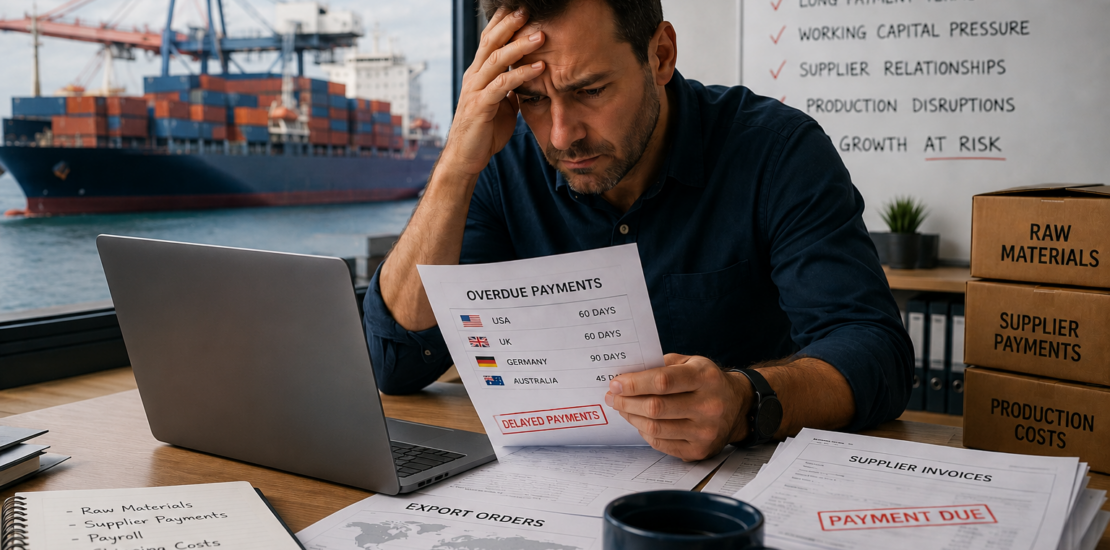
But 45 days later, the company’s finance manager walked into the president’s office with a problem.
Payroll pressure was building.
Suppliers were demanding payment.
Shipping costs had increased unexpectedly.
And the overseas customer still had not paid.
The payment terms were Net 90.
The company had revenue on paper — but not cash in the bank.
This situation is far more common in global trade than most people realize.
And in many cases, businesses do not fail because demand disappears.
They fail because cash flow timing collapses.
Why Export Cash Flow Problems Happen
In international trade, exporters often carry financial pressure long before payment arrives.
A supplier may spend money on:
- raw materials,
- labor,
- tooling,
- packaging,
- freight,
- inspections,
- customs documentation,
- and shipping,
weeks or even months before receiving payment from the buyer.
For smaller manufacturers and suppliers, this creates dangerous exposure.
One delayed payment can suddenly affect:
- payroll,
- inventory purchases,
- production schedules,
- supplier relationships,
- and future customer commitments.
The larger the order becomes, the larger the risk becomes.
Ironically, growth itself can create instability.
Exporters Often Focus on Revenue Instead of Working Capital
Many businesses celebrate new purchase orders without fully evaluating how the deal affects cash flow.
This is one of the biggest operational mistakes in international trade.
A deal is not truly profitable if the company cannot financially survive the payment cycle.
Experienced sourcing and operations leaders understand this clearly.
They do not evaluate opportunities based only on:
- unit price,
- sales volume,
- or annual revenue projections.
They also evaluate:
- payment timing,
- production exposure,
- inventory risk,
- currency fluctuations,
- freight volatility,
- and customer dependency.
Because in global sourcing, cash flow is strategy.
The Hidden Cost of Long Payment Terms
Large buyers often negotiate extended payment terms because it improves their own working capital position.
But what helps the buyer can severely pressure the supplier.
A manufacturer operating under:
- Net 60,
- Net 90,
- or even Net 120 terms
may effectively become the financing arm of the customer.
This becomes even more dangerous during periods of:
- rising freight costs,
- supply chain disruptions,
- tariff uncertainty,
- or commodity inflation.
The supplier absorbs the stress first.
And when exporters become financially strained, operational quality often suffers shortly afterward.
Production delays increase.
Communication weakens.
Quality escapes appear.
Supplier trust erodes.
What initially looked like a financial issue eventually becomes an operational issue.
Strong Exporters Manage Cash Flow Before Problems Begin
The strongest exporters are rarely the ones with the lowest prices.
They are usually the ones with:
- operational discipline,
- visibility,
- financial planning,
- and structured risk management.
They understand that stable cash flow creates negotiating power.
When a business has healthy working capital, it can:
- negotiate better supplier terms,
- respond faster to demand changes,
- maintain production quality,
- survive temporary disruptions,
- and make better long-term decisions.
This is one reason experienced global suppliers spend significant time building financial resilience into their operations.
Not just manufacturing capability.
A Better Way to Think About Export Growth
Many businesses approach exporting like a sales problem.
In reality, it is also a cash flow engineering problem.
Growth without liquidity can quietly destroy otherwise healthy companies.
That is why many experienced exporters now invest in:
- stronger financial infrastructure,
- trade-finance visibility,
- payment-risk management,
- and systems that improve working capital stability during long international payment cycles.
The companies that survive difficult global trade environments are often the ones that prepare financially before pressure arrives.
Not after.
Final Thought
In global sourcing and international trade, revenue creates excitement.
But cash flow determines survival.
A company can appear successful externally while internally struggling to sustain operations between production and payment.
The most experienced exporters understand something many growing businesses learn too late:
Winning the order is only the beginning.
Managing the financial gap afterward is what determines whether growth becomes sustainable.
About Bluemarble Consulting
Bluemarble Consulting shares insights on manufacturing operations, sourcing strategy, procurement, international trade, negotiation, and operational systems built from real-world global business experience.
Learn more at:
Bluemarble Consulting